


Duoflora: Human Strain Probiotics for Eczema

When Skin Keeps Asking for Help

Sometimes It’s Worth Looking Beneath the Surface.
If you or someone you love struggles with eczema, you know how exhausting it can be.
The itching.
The disrupted sleep.
The good days that never seem to last.
You’ve probably spent years trying to find a routine that works.

Different creams.
Different products.
Different approaches.
And yet the question remains:
“Is there something else I should be supporting?”
Researchers continue to explore how the skin, immune system, and gut microbiome work together.
And that conversation often begins somewhere unexpected.
Your gut.

You’ve Done Everything You Can for Your Skin

You’ve probably already made changes to your daily routine.
You may have become more careful about what touches your skin, what products you use, and even what you eat.
Maybe you’ve wondered if there was something else you could do.
Not instead of caring for your skin.
But alongside it.
Because healthy skin doesn’t function alone.
Your skin is connected to other biological systems that work behind the scenes every day.
Including your immune system.
And your gut microbiome.

The relationship between these systems is often described as the gut–skin connection.
Research continues to investigate how changes in the gut microbiome may relate to immune responses and skin health, including conditions such as atopic dermatitis.
This doesn’t mean that eczema begins in the gut.
It means the gut is one of the biological systems worth understanding when we’re thinking about the whole picture of skin health.
Why Do So Many Probiotics Disappoint?

This might be a question you’ve asked yourself before.
Maybe you’ve tried probiotics.
Maybe you stayed consistent.
Maybe you didn’t notice much difference.
Many probiotic products compete on:
More strains.
Higher CFU.
Bigger numbers.
But what if bigger numbers aren’t the most important thing?
What if the real question is:
How compatible is the probiotic with the human body?
That simple question became the foundation of Duoflora.
Compatibility Before Complexity
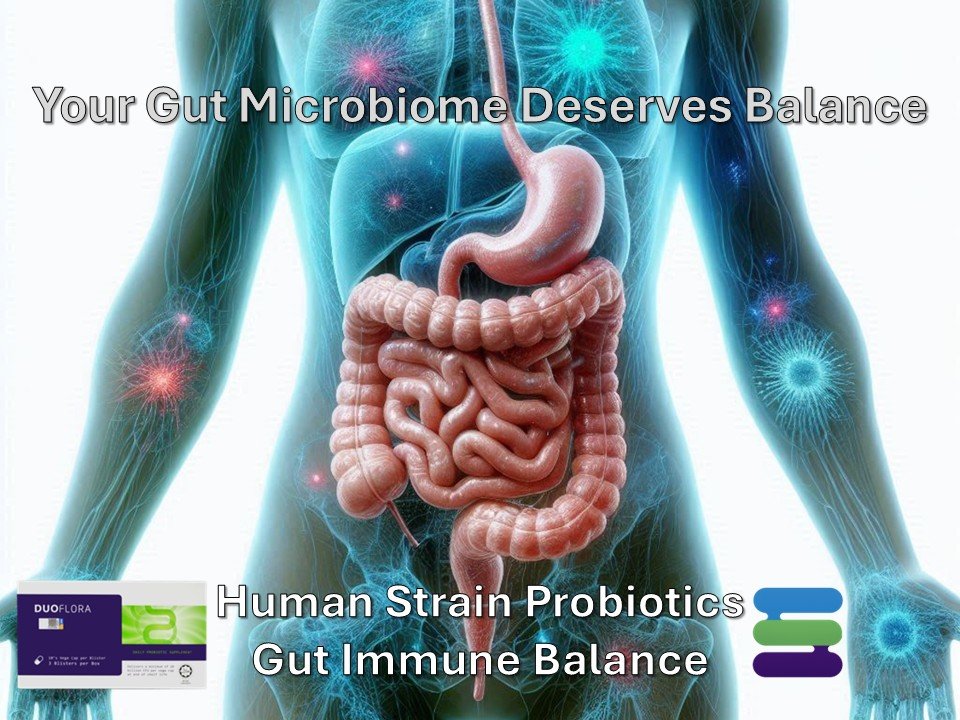
Most probiotics compete on quantity.
Duoflora was built around compatibility.
Because supporting the gut microbiome isn’t simply about adding more.
It’s about supporting a healthy microbial environment and the biological systems connected to it.
That’s why Duoflora uses Human Strain Probiotics — carefully selected probiotic strains originally isolated from healthy humans.
Not because they sound impressive.
But because they align with a simple philosophy:
Your body is human.
Your probiotic should be too.
The Gut Immune Balance System
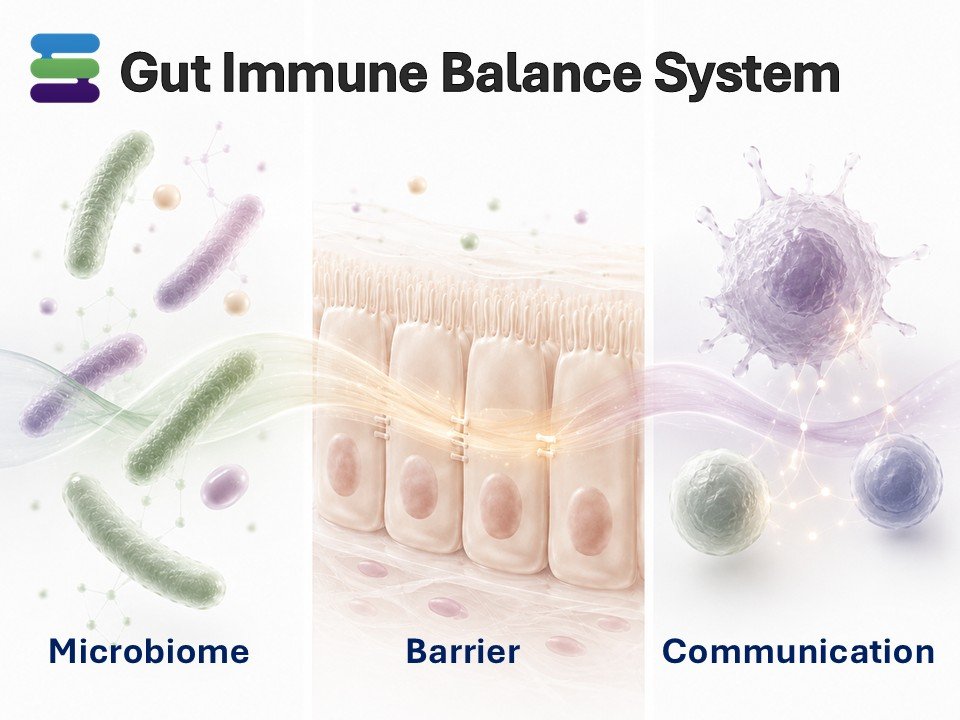
Duoflora supports gut–immune health through our Gut Immune Balance System.
A systems-based approach built around three connected areas:
Microbiome Balance
Supporting a healthy microbial environment within the gut.
Gut Barrier Integrity
Supporting the gut’s natural barrier function.
Gut–Immune Communication
Supporting the relationship between the gut microbiome and the immune system.
These systems work together.
And because the immune system is closely connected to skin health, supporting gut–immune health may be relevant to the broader picture of eczema and atopic dermatitis.
Gut Microbiome → Gut Barrier → Immune Function → Skin Health
[Learn More About the Gut Immune Balance System →]
Human Strain Probiotics

Duoflora contains two carefully selected Human Strain Probiotics:
Lactobacillus rhamnosus GG (LGG)
and
Bifidobacterium breve M-16V
Both strains have been studied in scientific research exploring gut health, immune function, and their potential relevance to allergic and atopic conditions.
The goal isn’t to use as many strains as possible.
It’s to choose strains with meaningful research behind them and formulate them around a clear biological purpose.
Human-Compatible Microbiome Balance
That is the principle behind Duoflora.
Backed by Published Research
The probiotic strains used in Duoflora have been investigated in published scientific research exploring atopic dermatitis.
Together, this body of research helps explain why the gut–immune connection has become an important area of interest in understanding eczema and atopic dermatitis.
Bifidobacterium Breve M16V: Its Role in Atopic Skin Health
Bifidobacterium breve M-16V has been investigated for its effects on the gut microbiome and immune responses, including in infants with atopic dermatitis.
Research has explored its potential to support a healthier microbial environment and influence immune responses associated with atopic conditions.

In a clinical study, infants with eczema were given Bifidobacterium breve M-16V or a placebo for one month. The probiotic group showed changes in fecal Bifidobacteria levels alongside improvements in clinical measures of atopic dermatitis.

Other research has investigated B. breve M-16V in infants with atopic dermatitis, including its relationship with immune markers and clinical symptoms.
Lactobacillus Rhamnosus GG: Immune and Atopic Health
Lactobacillus rhamnosus GG is one of the most extensively studied probiotic strains and has been investigated in relation to immune development and atopic conditions.
Research has explored its potential effects on immune regulation and the development or severity of atopic dermatitis.

Clinical studies have investigated L. rhamnosus GG in infants with atopic dermatitis, with some studies reporting improvements in clinical measures of eczema.

Other research has examined prenatal and postnatal supplementation with L. rhamnosus GG and the subsequent development of atopic disease in children.
Support One of the Systems That Supports Your Skin

Healthy skin doesn’t rely on one system alone.
Neither should the way you support it.
If you’re looking for a probiotic built around biological compatibility rather than bigger numbers, Duoflora offers a different approach.
A simpler philosophy.
A more thoughtful formulation.
A probiotic made for humans.
Duoflora: Human Strain Probiotics
References
Hattori K, Yamamoto A, Sasai M, Taniuchi S, Kojima T, Kobayashi Y, Iwamoto H, Namba K, Yaeshima T. [Effects of administration of bifidobacteria on fecal microflora and clinical symptoms in infants with atopic dermatitis]. Arerugi. 2003 Jan;52(1):20-30. Japanese.
Hulshof L, Overbeek SA, Wyllie AL, Chu MLJN, Bogaert D, de Jager W, Knippels LMJ, Sanders EAM, van Aalderen WMC, Garssen J, Van’t Land B, Sprikkelman AB; Clinical Study Group. Exploring Immune Development in Infants With Moderate to Severe Atopic Dermatitis. Front Immunol. 2018 Mar 29;9:630.
Isolauri E, Arvola T, Sütas Y, Moilanen E, Salminen S. Probiotics in the management of atopic eczema. Clin Exp Allergy. 2000 Nov;30(11):1604-10.
Kalliomäki M, Salminen S, Arvilommi H, Kero P, Koskinen P, Isolauri E. Probiotics in primary prevention of atopic disease: a randomised placebo-controlled trial. Lancet. 2001 Apr 7;357(9262):1076-9.
Kalliomäki M, Salminen S, Poussa T, Isolauri E. Probiotics during the first 7 years of life: a cumulative risk reduction of eczema in a randomized, placebo-controlled trial. J Allergy Clin Immunol. 2007 Apr;119(4):1019-21.
Huidrom S. Therapeutic Approach of Probiotics in Children with Atopic Dermatitis. Antiinflamm Antiallergy Agents Med Chem. 2021;20(1):2-9.